

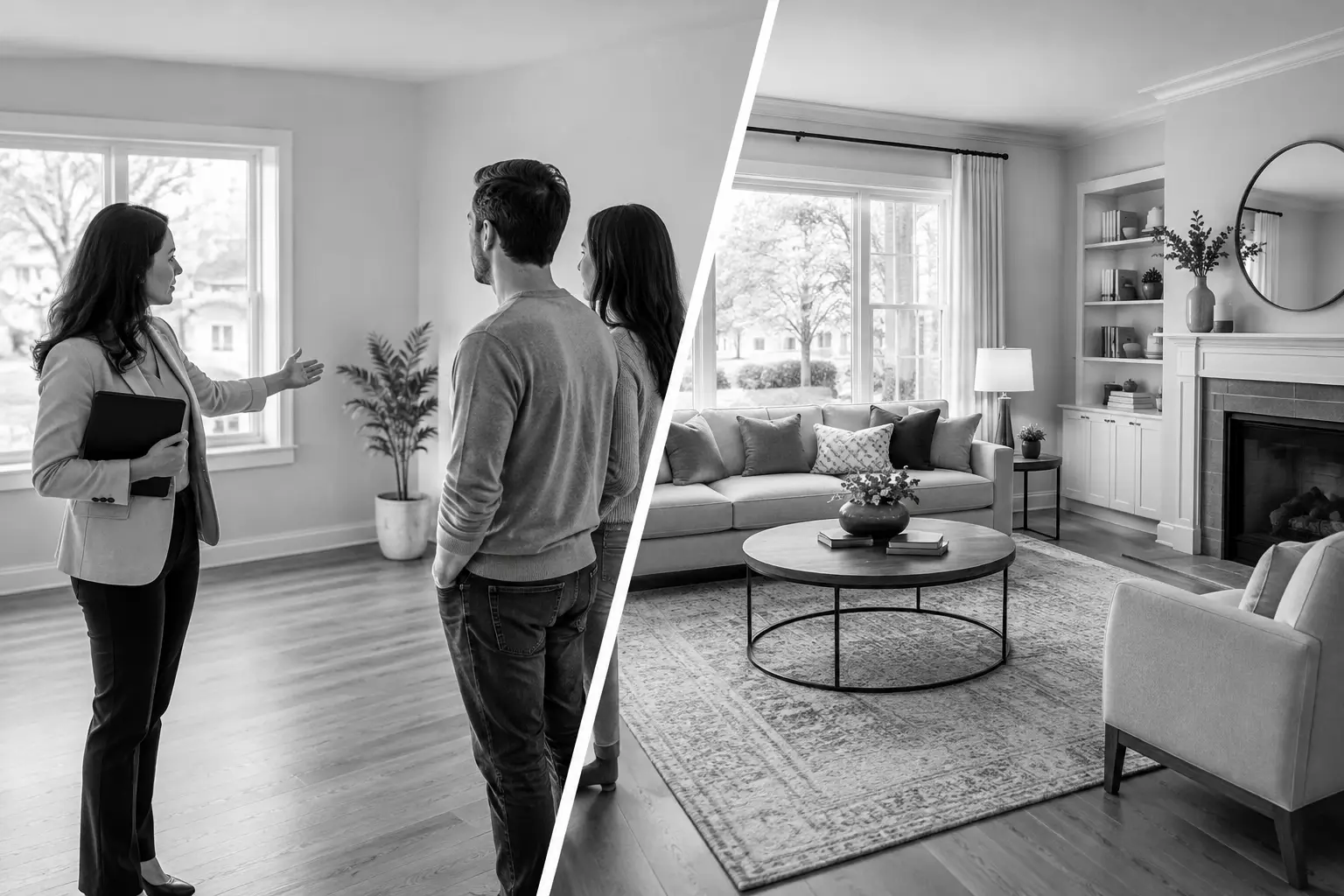
A vacant living room can make a 2,200-square-foot home feel smaller than it is. On the other hand, an occupied home with good natural light, appropriate furniture placement, and fewer personal items may need only targeted adjustments. That is the real question behind staging consultation vs full staging: how much preparation will help buyers understand the home quickly, and what is a sensible investment before listing?
A staging consultation involves a professional stager providing recommendations for changes using a home's existing items, best suited for occupied, well-maintained properties needing editing. In contrast, full staging means the stager supplies and installs all furnishings, art, and lighting, which is ideal for vacant homes or properties where room function is unclear. Both services aim to reduce buyer uncertainty, enhance photography, and support the home's pricing strategy.
For Chicago-area homeowners, the answer is rarely automatic. A consultation can be the right move for a well-maintained property in a desirable location. Full staging can be worth considering for a vacant home, a distinctive property, or a listing where room function and scale are hard to read without furnishings. The goal is not to make a home look like a catalog. It is to reduce uncertainty for buyers, strengthen the photography, and support the price and positioning strategy.
What a staging consultation actually provides
A staging consultation is an on-site review, usually conducted before photography and before the home goes live. A professional stager walks through the property and recommends changes the seller can make using what is already there, supplemented by selective purchases, rentals, or services when appropriate.
The recommendations often address furniture placement, traffic flow, clutter, window treatments, lighting, wall color, artwork, storage areas, exterior presentation, and which rooms should be photographed. In an occupied home, the consultant may advise removing a bulky sectional that blocks a fireplace, clearing kitchen counters, editing family photos, or turning a catch-all room back into a recognizable office or bedroom.
This is not simply a cleaning checklist. A good consultation considers how buyers will interpret each space. That matters in suburbs such as Barrington, Northbrook, Palatine, Lake Zurich, and nearby communities, where buyers may compare several homes with similar square footage but very different layouts, finishes, and levels of upkeep.
The seller typically does the work after receiving the recommendations. That keeps the direct cost lower than furnishing an entire property, but it also requires time, follow-through, and some willingness to live with a less personalized home while it is on the market.
When a consultation is often enough
A consultation tends to work well when a home is occupied, clean, maintained, and furnished in a way that generally shows room scale. It is especially useful when the main issue is editing rather than replacing everything the seller owns.
For example, a move-up seller may have a strong dining table, neutral sofas, and attractive built-ins, but also overflowing toy storage, crowded bookshelves, and a basement used for multiple purposes. The home does not necessarily need rental furniture. It needs clearer room definitions and a plan for showings.
A consultation also makes sense when a seller has a limited timeline or wants to direct more of the preparation budget toward repairs, painting, landscaping, or professional cleaning. Those items can have a more immediate effect if the home has visible deferred maintenance.
What full staging includes
Full staging generally means the stager supplies and installs furnishings, rugs, art, lighting, accessories, and sometimes bedding or tabletop details for all or selected rooms. The exact scope varies. Some homes receive furnishings throughout; others get a staged living room, dining room, primary bedroom, and a key flex space.
Most often, full staging is used for vacant properties. Without furniture, buyers can struggle to judge whether a living area accommodates a conversation area, whether a dining room fits a table, or how a lower level could function. Empty rooms also tend to photograph with less warmth and less visual reference for scale.
Full staging can also be useful for occupied homes whose furniture is badly undersized, overly worn, highly specialized, or inconsistent with the likely buyer’s expectations. A seller does not need to have poor taste for this to happen. Furniture that works beautifully for daily family life may not show a room’s dimensions or intended use as clearly as it could.
What are the trade-offs of full staging regarding impact, cost, and timing?
Full staging usually has more visual impact, particularly online, but it costs more and requires coordination. Sellers should ask how long the furnishings will remain in place, what happens if the listing extends beyond the initial rental period, whether installation and removal are included, and whether the proposal covers every room or only designated spaces.
There is also a practical question: will the staging solve the property’s real marketing challenge? Renting furniture will not correct dated bathrooms, a poorly priced listing, an unaddressed inspection concern, or photography that fails to show the home accurately. Staging works best as part of a coordinated listing plan, not as a substitute for one.
Staging consultation vs full staging: how to decide
Start with the condition of the home and the buyer’s first impression. If buyers can immediately understand each room, see the natural light, and imagine daily life there, a consultation may be enough. If buyers are likely to question room size, layout, or function, staging can provide useful context.
Next, consider occupancy. Vacant homes usually deserve a serious discussion about at least partial staging. A completely empty house can feel cold during showings, and listing photos may leave buyers with less to remember. For occupied homes, a consultation followed by decluttering, cleaning, and a few focused updates is often the more efficient path.
Then evaluate the financial decision in terms of likely return, not just the staging invoice. Sellers should compare the cost with the home’s price range, competition, timeline, and preparation needs. There is no universal rule that full staging produces a particular sale price or number of days on market. The value depends on execution and local buyer response.
A $900,000 vacant home with an open-concept main level may justify a more substantial presentation budget than a $400,000 home where the seller’s existing furnishings already show well. Yet price alone should not decide it. Some higher-priced homes need only a consultation; some modest vacant condos benefit significantly from a staged living space and bedroom.
How does staging integrate with the right pricing strategy?
Staging can help buyers pay attention to a home’s strengths, but it should not be used to defend an unrealistic list price. Buyers have access to photos, property details, and competing listings before they schedule a showing. If the price does not align with condition, location, features, and current competition, polished pillows will not resolve that gap.
The strongest approach is to decide on pricing, repairs, staging, photography, and launch timing together. That creates a consistent message: the home is presented honestly, priced thoughtfully, and ready for buyers to evaluate. It also prevents sellers from spending heavily on cosmetic presentation while overlooking a repair that will come up repeatedly in showings or inspections.
This is where full-service representation matters. A listing professional should help distinguish between changes that improve marketability and changes that simply consume budget. At Spot Real Estate, that conversation is part of protecting seller equity: make informed investments in the listing, understand listing-side commission and any separate applicable fees, and keep buyer-broker compensation separate and negotiable where applicable.
Questions to ask before approving a staging plan
Before committing, ask the stager which rooms are most important, what specific buyer objection the plan is designed to address, and what the property will look like in photos. Ask for a written scope that identifies rental duration, delivery, installation, removal, damage responsibility, and extension costs.
It is also reasonable to ask whether partial staging would accomplish most of the goal. In many homes, the living room, dining area, primary bedroom, and one flexible room carry the visual load. A staged office can clarify remote-work potential; a staged lower-level room can prevent buyers from seeing it as unfinished or purposeless.
Finally, ask your real estate professional to explain how the staging recommendation fits the pricing and launch plan. If the answer is vague, pause. Preparation choices should be tied to the specific home and the likely buyer, not treated as a standard package every seller must buy.
The best staging decision is the one that makes the home easier to understand without spending more than the market position justifies. Sometimes that means a detailed consultation and an organized weekend of preparation. Sometimes it means bringing a vacant home to life. Either way, clear advice and disciplined spending leave more room to protect what you net at closing.